
When you hear the word “STEM”, you might picture older students coding robots, building bridges or running science experiments in a high school lab. But did you know that the building blocks for STEM – Science, Technology, Engineering and Mathematics – actually start developing right from birth?
At ONE Early Education, our program recognises that curiosity, problem-solving and critical thinking don’t magically appear in later years. They are nurtured through everyday play, conversation and exploration.
Today, more early learning centres across Australia are embracing STEM in the early years because research shows that children are natural scientists, engineers and mathematicians. When toddlers tip water between cups, stack blocks into towers, or wonder what makes a rainbow, they’re already using the basic skills they’ll need later to solve complex problems.
Why Early STEM Learning Matters
Early childhood is a unique window of rapid brain development. In these years, children form the foundations for how they learn, ask questions and find solutions.
Engaging with STEM concepts at a young age doesn’t mean formal lessons or worksheets. It means creating playful, hands-on opportunities for children to experiment, test ideas and think creatively.
Research shows that early STEM play helps children:
- Build confidence in experimenting with new ideas
- Develop persistence and resilience when things don’t work the first time
- Strengthen language and communication skills by describing what they see and do
- Lay the groundwork for literacy and numeracy in school
- Learn to collaborate with peers, share materials and solve problems together
Best of all, young children are naturally wired to wonder how and why. At ONE, we believe our role is to nurture that spark, not limit it.
How ONE Learn Brings STEM to Life
In our ONE Learn curriculum, STEM is not an add-on or a one-off project. It’s woven through daily experiences, from our ONE Infant rooms through to preschool. We know that big ideas don’t need to wait until primary school – they can be explored in playful, meaningful ways right now.
Here’s how we introduce STEM to our youngest learners:
1. Science Through Sensory Play
Science starts with the senses. Babies and toddlers explore concepts like cause and effect, texture, temperature and change through messy play, sand and water play, gardening and cooking activities.
For example, our children might experiment with what sinks or floats, watch how ice melts on a warm day, or grow seeds and notice how plants need sunlight and water. These experiences build observation and prediction skills naturally.
2. Technology in Age-Appropriate Ways
In the early years, technology is not just about screens. At ONE, we introduce age-appropriate tools and materials to show children how technology helps us in daily life.
This might include using digital microscopes to look closely at leaves, listening to stories recorded by educators, or using simple, child-safe coding toys that teach the basics of sequence and direction.
3. Engineering Through Building and Creating
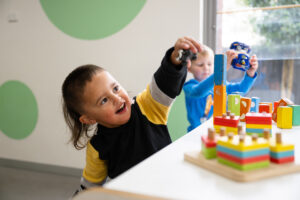
Every time a child stacks blocks, connects train tracks or builds a den with blankets and chairs, they are exploring engineering principles.
Our educators encourage children to design, test and rebuild. What happens if the bridge doesn’t hold? What makes the tower fall? What can we do differently next time? These questions help children practise trial and error and celebrate problem-solving.
4. Mathematics in Everyday Moments
Early maths is about so much more than counting to ten. It’s patterns, measurement, shapes, time and spatial awareness.
Our curriculum makes maths visible in everyday routines. Children measure ingredients when cooking, sort natural materials by size and shape, compare heights when building towers, or notice patterns in music and movement. Educators use open-ended questions and rich language to help children build confidence with mathematical ideas long before they see them in a workbook.
Learning Through Relationships
One of the reasons STEM is so powerful in the early years is that it happens through relationships. Our educators model curiosity by asking “I wonder what would happen if…” or “How could we find out more about this?”
Children feel safe to take risks and try new things when they know mistakes are part of learning. They learn to ask questions, share ideas and listen to others’ theories: essential skills for life, not just for science class.
Real STEM Projects at ONE
Across our centres, you’ll see real examples of STEM in action every day. You might find toddlers investigating shadows in the outdoor yard, kinder kids testing how different materials slide down a homemade ramp, or infants exploring light and colour with safe, sensory materials.
We plan STEM experiences around children’s interests and extend them with open-ended materials like blocks, loose parts, water, sand, natural objects and recycled items. When children are interested, they are more likely to stay engaged, try new ideas and develop a love of learning that carries through to school and beyond.
Building Skills for a Changing World
Jobs of the future will look very different from today, but the skills children need to thrive remain the same: creativity, critical thinking, collaboration and resilience.
By embedding STEM experiences early, our Brain Development program helps children develop the mindset to ask questions, test possibilities and see failure as a stepping stone rather than an end point. These are skills that will serve them well in school and in life.
Supporting Families to Continue STEM at Home
We know families play a big part in nurturing curiosity. That’s why our educators share simple STEM ideas you can try at home, like building with recycled boxes, exploring nature walks, or cooking together.
We also share photos and stories of STEM experiences at ONE, so you can talk with your child about what they’re discovering. When home and centre work together, children see that learning happens everywhere.
Curious Minds Start Here
STEM starts with a child’s natural curiosity. At ONE Early Education, our curriculum creates an environment where every child is encouraged to wonder, investigate and create, supported by caring educators who turn everyday moments into powerful learning.
If you’d like to see how we bring STEM to life for even our youngest learners, we invite you to book a tour and experience ONE for yourself. Let’s grow curious minds together, ONE discovery at a time.